Solve now, or learn more?
When several answers remain, every guess changes the possibilities in front of you.
An answer attempt keeps the immediate possibility of solving the word.
An evaluator is played principally for the information it can reveal about the answers still possible.
Neither is automatically better. If one answer remains, the route is clear. If several closely related answers remain, learning more before you commit may be the stronger decision.
Choose one of the answers still possible and keep the immediate chance of finishing the level.
Use the guess primarily to separate the possibilities and make the next decision clearer.
Think in possibilities, not just letters
A guess is not valuable simply because it uses five fresh letters.
What matters is how the possible feedback from that guess divides the answers that are still in play.
Suppose six answers remain. One guess might split them into two groups of three. Another might create six different feedback patterns, one for each answer.
The second guess leaves the next decision much clearer, even though both guesses used the same five-letter format.
Information theory gives us a formal way to describe this. Shannon entropy measures how much uncertainty a guess is expected to remove. You do not need to calculate it while playing: the useful idea is that different guesses can divide the same remaining answers very differently.
Entropy is evidence, not the whole answer. Solve probability, the worst possible branch and the structure of the remaining words still matter.
Whichever branch arrives, three answers remain.
Every feedback branch identifies a single answer.
When close becomes a trap
Sometimes a pattern looks almost solved, but the remaining uncertainty is concentrated in one position.
Imagine these eight answers are still possible: BOUND, FOUND, HOUND, MOUND, POUND, ROUND, SOUND and WOUND.
The pattern is obvious. The answer is not.
If the only uncertainty is the first letter, guessing through the family one answer at a time can consume several attempts.
Being close to the word is not necessarily the same as being close to knowing the word.
A stronger route may test several of the distinguishing letters together before returning to the answer family.
But when concentration dips, it is all too easy to throw one of the family words in — and then it is too late. Down we go.
CLOUD points clearly to _OUND, but it still leaves eight plausible answers in play.
Two deliberate information plays can test several distinguishing letters and reduce the family more efficiently than guessing BOUND, SOUND, HOUND and the rest one by one.
In some word games, a trap like this can effectively end the run or the streak. In Ascendle, it is not automatically game over — but it is still better not to go down rabbit holes when Every Guess Counts.
Evaluator, burner or trap breaker?
These terms are useful when they describe what a guess does to the position, rather than pretending to know what a player was thinking.
A guess whose principal value is the information it reveals across the answers still possible.
A narrower evaluator that gives up the immediate solve opportunity to attack a concentrated ambiguity.
A burner aimed specifically at separating a difficult word family or trap.
A good decision can get a bad result
Feedback arrives after the decision has been made.
A strong route can receive an awkward feedback branch. A weaker route can happen to land directly on the answer.
The number of guesses tells you what happened. It does not, by itself, tell you how good every decision inside the solve was.
This is why Ascendle separates evidence about SKILL — the quality of the decision using the information available at the time — from LUCK — how favourable the feedback branch turned out to be.
Play first. Then look again.
Ascendle's analysis comes after the play. The purpose is not to interrupt a solve with advice, but to help you understand the route once the decisions have been made.
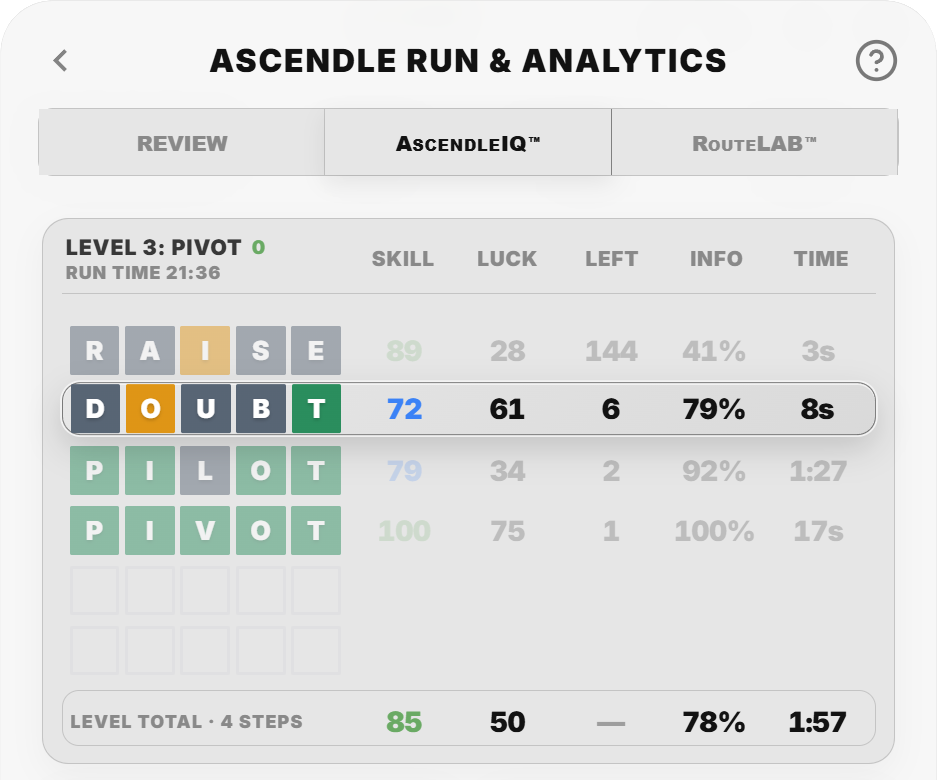
AscendleIQ™ looks back at the route you actually played: what remained before each guess, how the feedback changed the position and how the run developed.
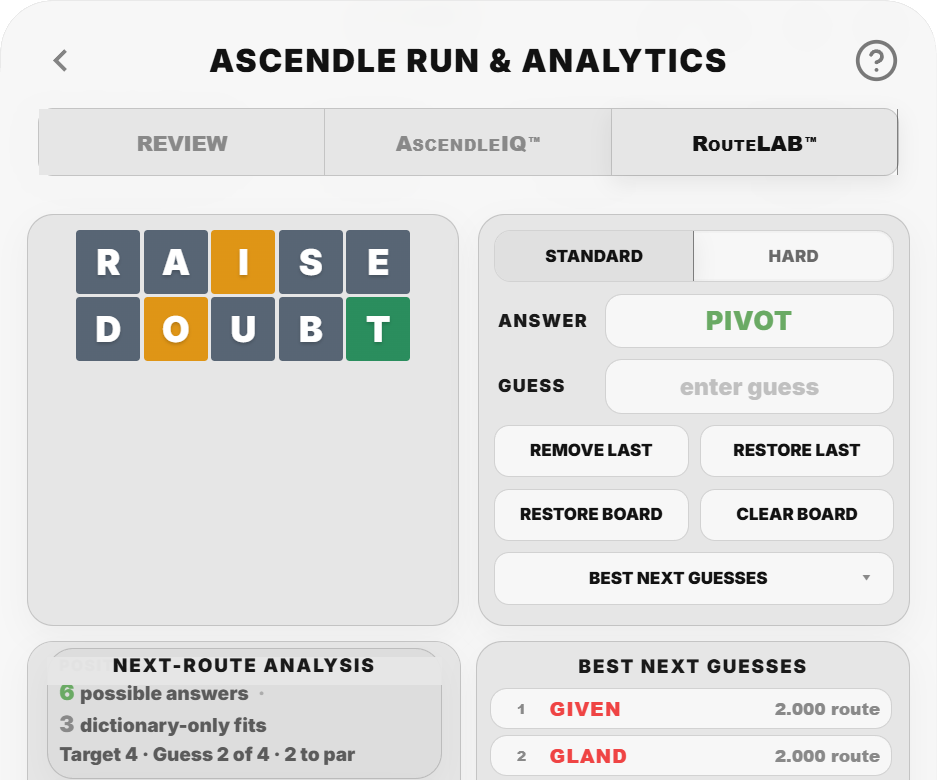
RouteLAB™ lets you revisit a completed position and explore alternatives — possible answers, different next guesses and the routes they create.
AscendleIQ is the coach. RouteLAB is the laboratory.