Word familiarity isn’t universal
Words such as PSHAW, BUTTE and LORRY — thanks to The New York Times’ Wordle® — and some from Ascendle’s own recent puzzle answers, MILCH, MIAOW and HUMPH, can provoke very different reactions.
One player sees something familiar. Another sees something obscure, regional, old-fashioned, specialised or simply outside their everyday vocabulary.
There is no single vocabulary shared equally by every English-speaking player.
Where you live matters. So can what you read, what you do for a living, the language you grew up around, your age, your interests and simply which words you have happened to encounter before.
A British player may regard one word as completely routine while an American, Australian or New Zealand player encounters it far less often. A word familiar to someone who reads widely may be unknown to someone equally capable at word puzzles. Technical, historical, botanical, geographical and colloquial language all create similar differences.
And sometimes there is no obvious demographic explanation at all.
You just know the word — or you don’t.
That means familiarity is not the same thing as difficulty.
A structurally simple word can be difficult if you have never encountered it. A supposedly unusual word can be straightforward if its letters reveal themselves cleanly. And a very familiar everyday word can become horrible when it sits inside the wrong family of possible answers.
That distinction matters to Ascendle because a five-level game cannot simply classify words as easy or hard and assume every player will experience them in the same way.
Same answer. Same letters. Very different prior familiarity.
Unfamiliar doesn’t necessarily mean unfair
There are two equally unsatisfactory extremes in word-game design.
At one extreme: “It appears in a dictionary, therefore it is fair.”
That is too simplistic. Dictionaries contain enormous numbers of words that would make terrible everyday puzzle answers.
At the other: “I didn’t know it, therefore it should never have been an answer.”
That cannot really work either. No practical answer list could be restricted to words familiar to every possible player.
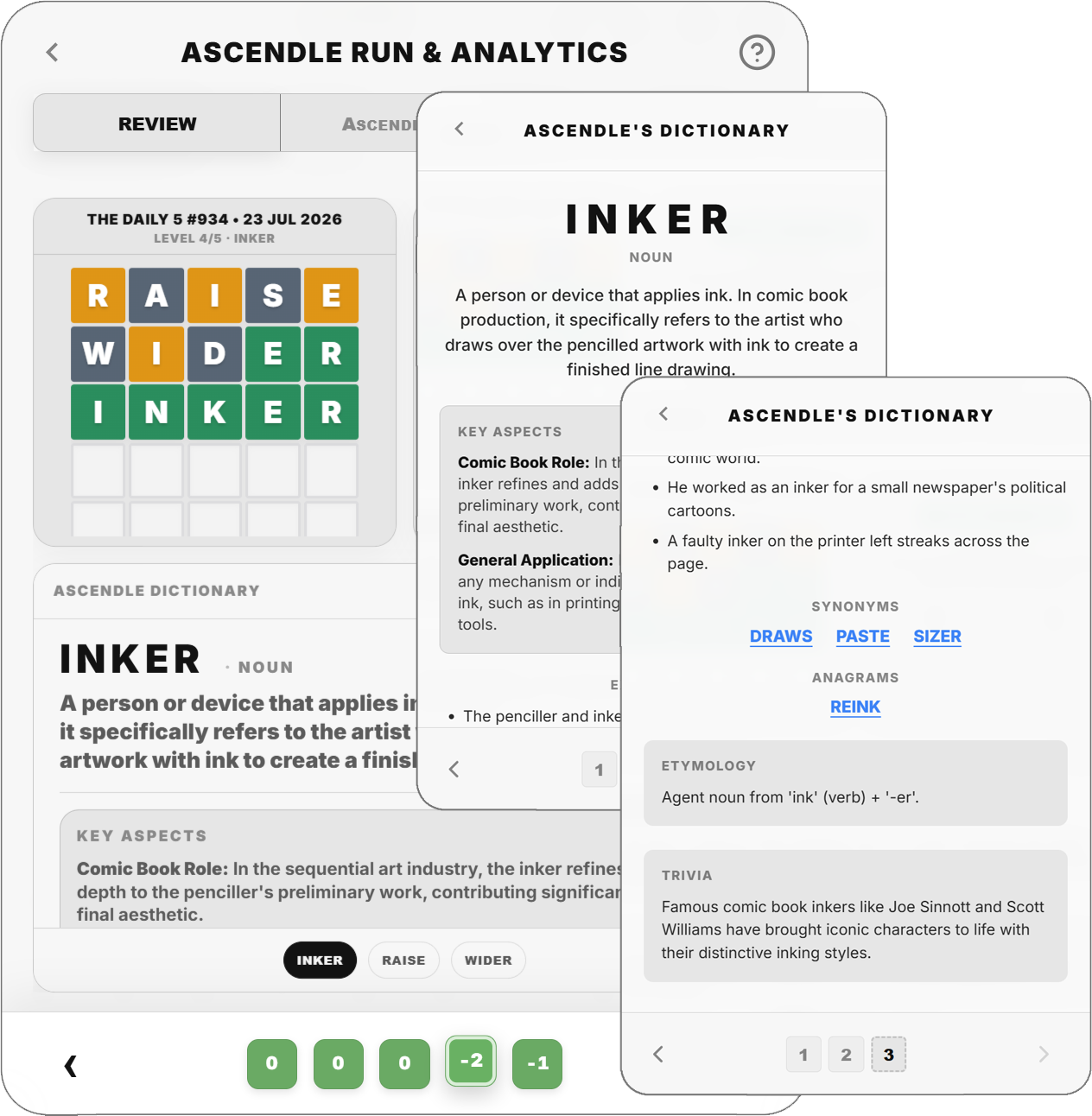
Ascendle therefore separates the broader vocabulary a player may legitimately use as a guess from the more deliberately governed pool of words eligible to become answers.
That distinction is important.
A generous guess vocabulary gives players freedom to explore language, test letters and use tactical words.
The answer vocabulary has a different responsibility. It has to support a game that feels varied, defensible and interesting over a very large number of plays.
So the question is not simply: “Is this a real word?”
It is closer to: “Is this an appropriate word to place into this game, in this context, as part of this five-level journey?”
And even then, no system can guarantee that every eligible answer will feel equally familiar to every player.
Five words changes the problem
Ascendle does something unusual for this kind of game: Every Daily 5 contains five answers.
That changes the scale of answer scheduling dramatically.
A one-answer-per-day game exposes 365 daily answers in a year.
Ascendle Daily 5 exposes 5 × 365 = 1,825 answer positions every year.
At that scale, several design problems become much more important.
Words will eventually recur. Particular letter structures will recur. Double letters will recur. Unusual words will recur. Word families will recur.
And if those things are governed badly, players will notice.
So the sensible promise cannot be: “An answer will never repeat.”
With a finite curated answer pool and five answers every day, recurrence is inevitable.
The more useful objective is to avoid obvious clumping and make recurrence something that can be measured, investigated and governed rather than pretending it can be eliminated altogether.
A word appearing again is not automatically evidence of a bad schedule.
The more interesting questions are: How recently did it appear? Has it appeared unusually often? Did it repeatedly occur at the same level? Are particular structures becoming over-represented? Does the wider schedule still feel varied?
Those are fundamentally different questions from simply maintaining a giant blacklist of previously used words.
Daily answer positions in a year.
Five answer positions every day, all year.
More exposure makes recurrence, structure and schedule texture matter more.
Fair doesn’t have to mean predictable
This leads to one of the central ideas behind Ascendle: Fair, but not fully predictable.
At first that can sound contradictory. It isn’t.
Imagine playing for several months and discovering that Level 1 can never contain a repeated letter; an unusual answer can only appear at Level 5; a particular kind of word ending can never be selected; Levels 1 and 2 are guaranteed to contain straightforward structures; or once a word has appeared, it cannot return for a known number of days.
Those might initially sound like player-friendly rules.
But once players learn them, the rules themselves become additional clues.
You would no longer be solving only from the letters on the board. You would also be solving from your knowledge of the generator.
“It cannot be that word because Ascendle never puts those at Level 2.”
At that point the schedule has become partially solvable.
Ascendle deliberately avoids that.
A normal pattern can be strongly preferred without becoming an absolute rule. An unusual structure can be suppressed without being made impossible. An early level can usually be more approachable without becoming guaranteed to be easy.
The game can therefore have a recognisable shape without turning into a mechanical staircase.
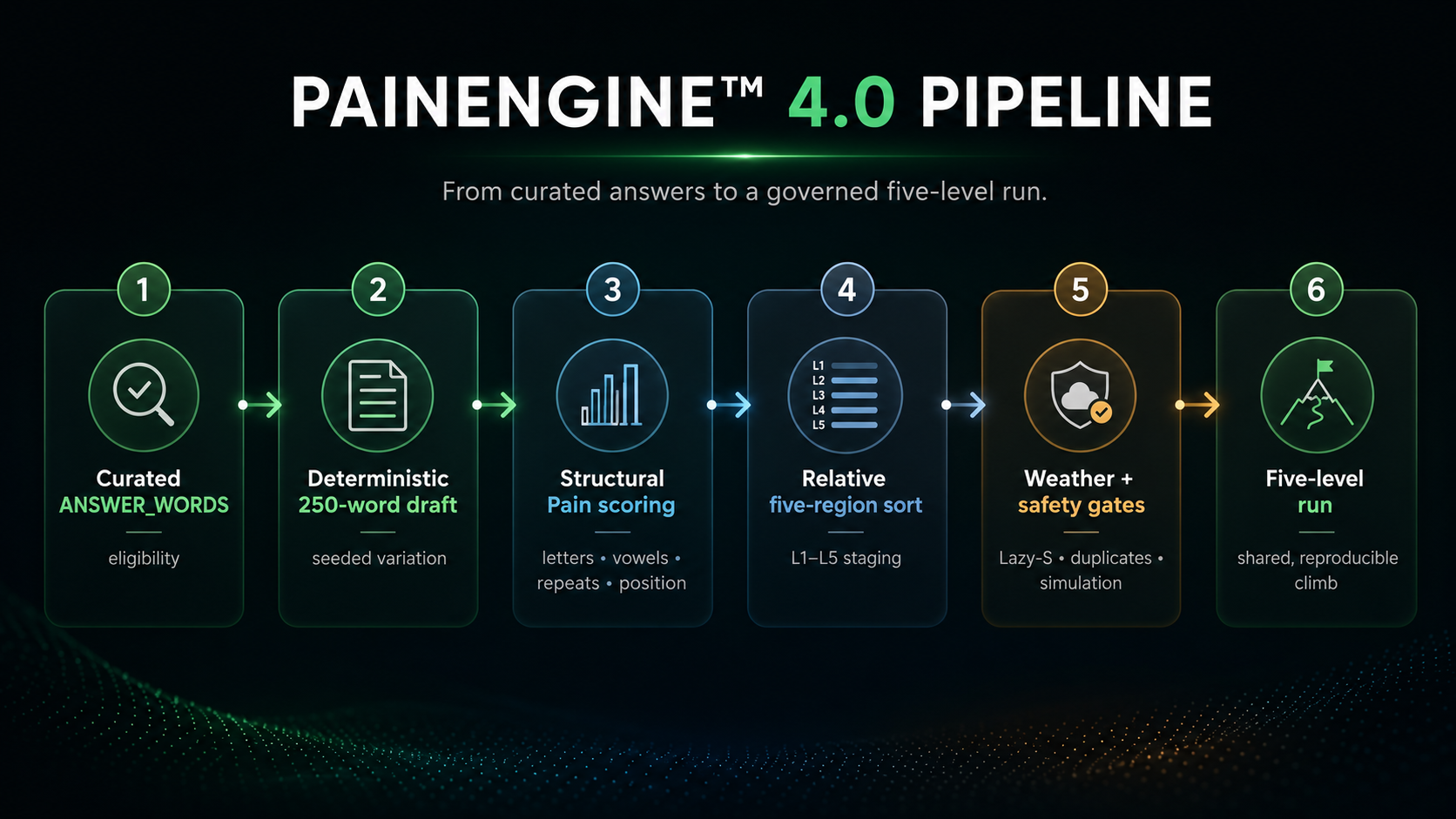
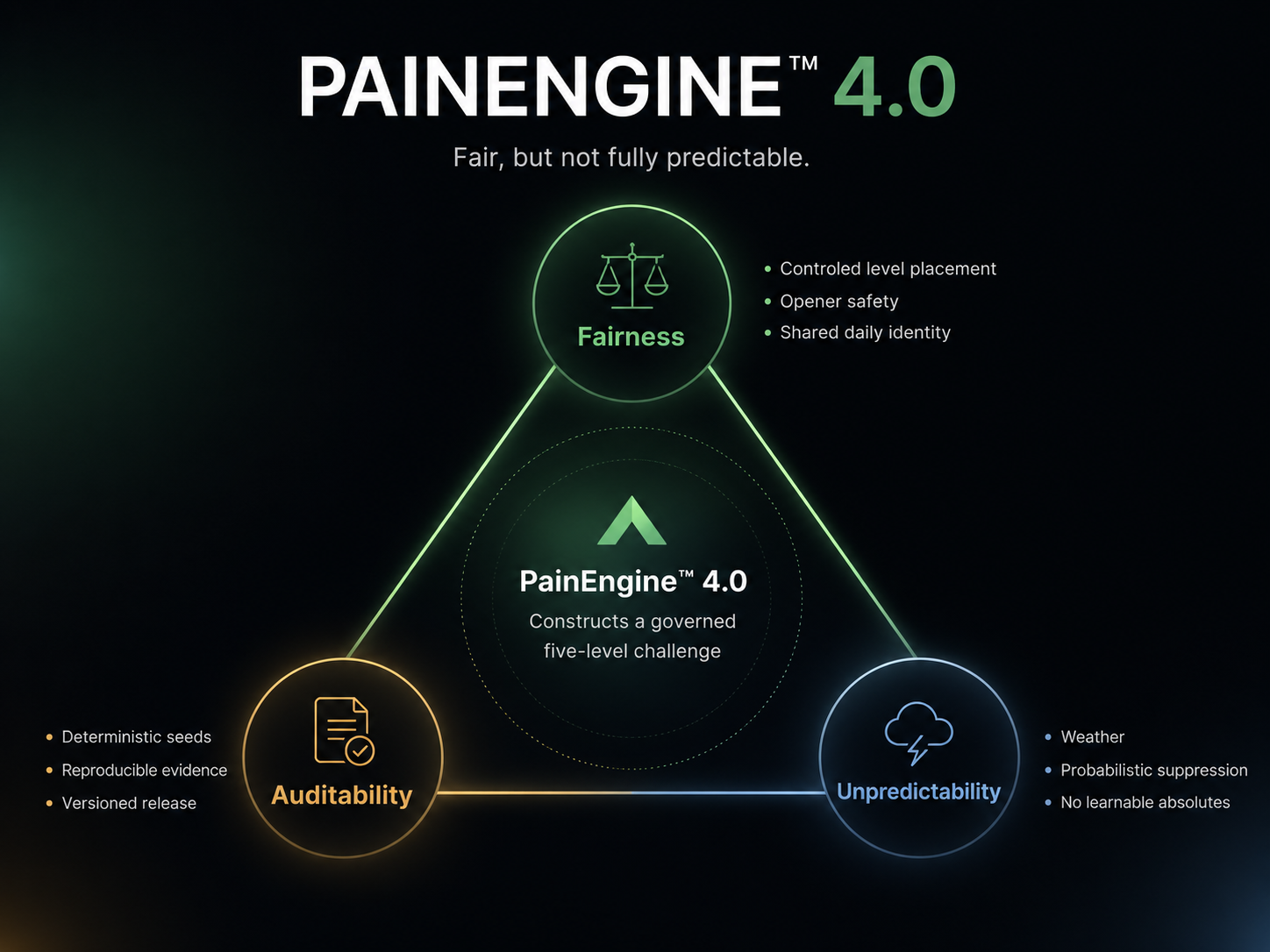
That philosophy is built into PainEngine™ 4.0: bounded unpredictability inside a deterministic system. The same seed produces the same challenge for everyone, while controlled variation prevents players from learning absolute scheduling rules that themselves become clues.
REAL ASCENDLE EXAMPLE
A real example of controlled variation
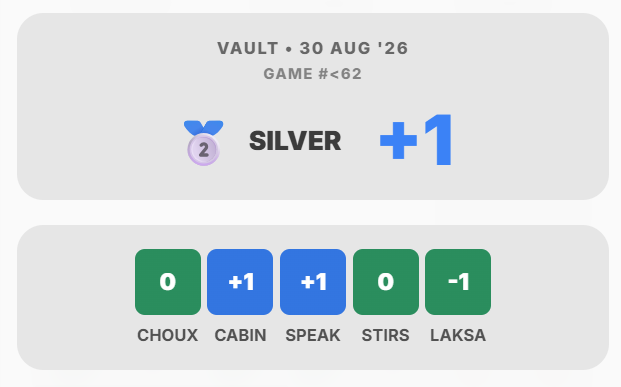
CHOUX might look like a word more naturally associated with a later level, yet here it appeared at Level 1 and was solved in four — exactly on target. That is part of what “fair, but not fully predictable” means in practice.
An unexpectedly difficult opening board does not decide the run. Ascendle is scored across five levels, so a +1 or +2 early can still be recovered through strong play over the boards that follow. Equally, a familiar-looking word can sometimes prove far more troublesome than expected.
PainEngine™ shapes the five-level journey around probabilities and structural difficulty, while leaving enough variation for individual words — and individual routes — to surprise you.
How Ascendle shapes the five-level journey
Ascendle does not simply choose five eligible answers at random and place them onto five boards.
PainEngine™ helps shape those answers into a five-level journey.
The aim is not to pretend that a numerical system can know exactly how difficult a word will feel to every human being.
It cannot.
Instead, the engine considers structural characteristics of words and uses them to help create the overall progression of a run.
Ordinarily, that means the challenge becomes more demanding as the player moves from Level 1 towards Level 5.
But ordinarily is an important word.
Ascendle deliberately allows controlled variation.
An early board can occasionally bite. A familiar word can behave unexpectedly. A later level may unfold more cleanly than anticipated. And some structures that are generally discouraged can still occasionally appear.
That is intentional.
A completely rigid five-stage ladder would eventually become predictable. A completely random sequence would lose the sense that the five boards belong together.
Ascendle attempts to live between those two extremes.
The underlying PainEngine architecture is deterministic and curated, while the five-level route is deliberately shaped rather than mathematically equalised from day to day.
Difficulty is more than the word
There is another reason we are cautious about describing any answer as simply easy or hard.
The answer is only part of what happened.
Consider two players facing exactly the same word.
One opens with letters that expose most of its structure immediately. The other follows a route that leaves several very similar possibilities.
One player sees a familiar pattern. The other enters a trap family.
One uses an evaluator that separates the remaining answers. Another starts testing possible solutions individually.
One gets an extraordinarily helpful feedback branch. The other receives the least useful branch the same good guess could have produced.
Same answer. Very different game.
This is why Ascendle increasingly looks at the route, not merely the result.
A five-guess solve is not automatically poorer play than a four-guess solve. A guess can be strategically excellent and receive an unfortunate result. Another can be strategically weak and happen to land on exactly the right branch.
A player might deliberately use an evaluator to gather broad information. In a concentrated word family, that evaluator may become something more specific: a burner or trap breaker, sacrificing an immediate solve opportunity because separating the remaining possibilities is strategically more valuable.
And importantly, simply playing a word that cannot currently be the answer does not automatically make it a burner. Its function depends on what it actually did to the position.
These are exactly the kinds of distinctions explored further in Improve Your Game, and they are why AscendleIQ™ and RouteLAB™ look beyond the final guess count.
The Ascendle principle
Ultimately, the design problem is bigger than choosing “easy words” and “hard words.”
Ascendle is trying to hold three things in balance:
Players facing the same challenge should receive the same underlying route. Answers should come from a deliberately governed pool. The five levels should have shape and purpose rather than being five unrelated random picks.
The game should not reveal enough absolute rules that experienced players can begin solving the generator instead of solving the words. Variation is therefore not necessarily a flaw. Sometimes it is part of the design.
When something unusual happens, the game should have an underlying explanation that can be investigated: why an answer appeared, how the route was shaped, whether a word has appeared recently and whether the route itself created the difficulty.
Familiar isn’t the same as fair. And fair isn’t the same as easy.
Someone, somewhere, will look at PSHAW, BUTTE, LORRY, MILCH, MIAOW or HUMPH and wonder what on earth the game was thinking. Someone else may solve the same word without giving it a second thought.
That difference cannot be engineered away — and we don’t think it should be.
The objective is not to make every word equally familiar. It is to build a game in which the answer pool is governed, the five-level journey is deliberate, unusual moments remain possible, and the system does not become so predictable that knowing its rules becomes another way to solve the puzzle.
Fairness. Unpredictability. Auditability.
Five levels give Ascendle far more opportunities to surprise you. The important part is making those surprises defensible.
Wordle® is a trademark of The New York Times Company. Ascendle® is not affiliated with or endorsed by The New York Times Company.